Official Poster of the 28th Shanghai International Film Festival Released
On May 15, the 2026 SIFF & STVF held a press conference in Beijing. Guided by the China Film Administration and hosted by China Media Group (CMG) and the Shanghai Municipal People’s Government, the 28th Shanghai International Film Festival (SIFF) will take place from June 12 to 21. Hosted by the National Radio and Television Administration (NRTA), CMG, and the Shanghai Municipal People’s Government, the 31st Shanghai TV Festival (STVF) will be held from June 22 to 26.At the press conference, the poster of this year’s SIFF themed “Lights, Camera, Stories” was unveiled.
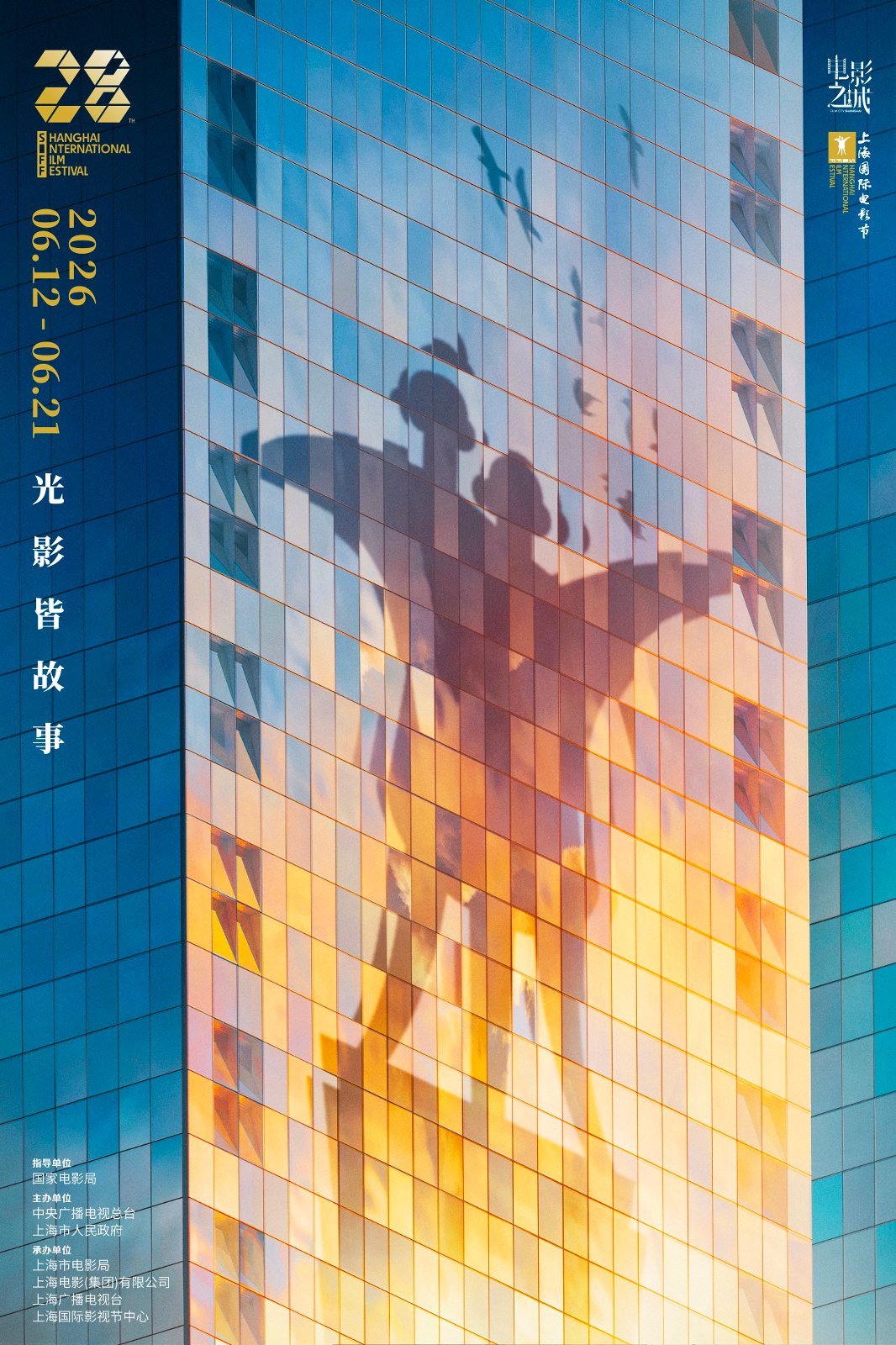
Official Poster of the 28th SIFF
Designer Lin Xi: When Film and TV Meet a City — Shanghai is full of stories, and full of promise
“Shanghai, as a city of film and a major hub for television, has many different facets and textures. I wanted to use the poster to show that.” said Lin Xi, the young designer behind the official visuals for the 28th SIFF and the 31st STVF. According to Lin, this year’s posters, themed “Lights, Camera, Stories” and “Blooming Futures”, seek to capture the deep connection and shared growth between film, television, and Shanghai, an international cultural metropolis.
Structural Aesthetics and the Cyber Magnolia
At the heart of the 28th SIFF’s poster is a striking image: the festival’s Golden Goblet trophy reflected on a glass curtain wall, becoming part of the city’s unique skyline alongside birds and drifting clouds.
Lin Xi’s inspiration came from a scene he once captured — sunset light cast across a glass wall, its luminous beauty quietly striking. He had also seen many photos taken by netizens of the Shanghai World Financial Center, where the Oriental Pearl Tower, reflected on the glass, reveals glimpses of urban life that he found utterly captivating. “The Golden Goblet trophy is a symbol of the film festival,” Lin explains. “Placing it on the curtain wall allows the city to tell its own cinematic stories.”
Just as cinema comes from life but goes beyond it, the seemingly casual glimpse of the glass wall in the poster holds subtle intricacies. Lin employs a technique akin to moving perspective — cutting, shifting, and reassembling fragments of the cityscape.
“It’s called an axonometric perspective — many industrial renderings are axonometric drawings. I used this structural approach to show the relationship between life and cinema,” Lin explains. “With every step you take, the reflection on the glass wall changes, as if everyday fragments of the city are being reassembled into a sequence of scenes.” He says he chose this non-realistic perspective to soften the sense of reality, to find a balance between the real and the virtual, and to create space for imagination — which resonates with the dream-making power of cinema.
For the key visual of the 31st STVF, Lin Xi took a different approach, using a hand-painted style reminiscent of watercolor to complete this year’s creative vision. At the center of the image is a five-colored magnolia, rendered in traditional Chinese ink and wash. The vibrant hues stand in stark contrast to the clean, light washes of the background — a striking expression of the “negative space” aesthetic found in Chinese brush painting. The five colors — cinnabar red, indigo, gamboge yellow, verdigris green, and ochre — are far from arbitrary. Each is derived from traditional Chinese mineral pigments and carries its own symbolic meaning: good fortune, vitality, brilliance, energy, and depth, respectively.
It is also a five-colored magnolia that bridges tradition and modernity. On the petals, Lin Xi has innovatively incorporated the ubiquitous “framing box” of digital visual creation — a rectangle found in traditional cameras and camcorders when framing a shot, as well as in modern motion capture technology and color-picking tools for visual design. “The framing box appears everywhere,” he says. The overall imagery of the poster is thus placed within an interactive context of “digital framing,” embedding digital visual language into a traditional motif. It also symbolizes how, at a time when the global television industry is rapidly evolving toward digitalization, intelligence, and diversified distribution, technology continues to lead and reshape the logic of content production, the way stories are told, and the viewing experience for audiences.
This approach also adds a futuristic, cyber dimension to the real-life Magnolia — Shanghai’s city flower, known for its pure white and elegant beauty—offering a perfect interpretation of the theme “Blooming Futures”.
Shanghai, in Every Detail
In both posters, urban elements are subtly interwoven with cinematic imagery, creating a wealth of detail. For instance, the number 28 — marking the 28th edition of the festival — is suggested through the fragmented, cut-glass geometry of the curtain wall reflection. Lin explains that his design approach follows a consistent logic: “to express through imagery, to convey meaning through scenery — never presenting elements too directly, but inviting viewers to discover the depth in the details.”
For Lin, the theme of this year’s SIFF poster, “Lights, Camera, Stories”, is embodied in those very details. “When the new Golden Goblet trophy appeared as a reflection on the glass, I noticed an unexpected resemblance to a dancing figure in front of a hotel from last year’s poster series. It was a small, delightful echo. To me, dance is one of the defining symbols of modern Shanghai’s cultural life.”
Lin, who is based in Beijing, spent a few months living in Shanghai last year and made a special trip back during the festival to watch films — as an ordinary movie lover. That experience gave him a deeper, more well-rounded understanding of the city and its cultural fabric. “Shanghai is not just one thing,” he says. “The tree-lined alleys are Shanghai. The towering skyscrapers of the modern metropolis are also Shanghai. I wanted to present a different, more multifaceted Shanghai.” Seen alongside last year’s poster, the two works together offer a complete portrait of the city — moving from its everyday warmth to its international sophistication.
In recent years, SIFF has seen its global influence and reputation continue to grow, along with an ever-expanding network of international partners. Following a newly released list of officially certified “A”-list film festivals by the International Federation of Film Producers’ Associations (FIAPF), SIFF secured its place among them thanks to its outstanding performance across the board. “Being reaffirmed as China’s only A-list film festival reflects the event’s industry standing and global vision—and this year’s poster carries that meaning as well,” Lin Xi added.
In the TV festival poster, the five-colored magnolia gives tangible form to Shanghai’s inclusive urban spirit and the growing international influence of STVF. In recent years, the festival has extended its call for entries to all five continents, receiving over a thousand submissions from around the world. The five petals of the magnolia symbolize this convergence of outstanding screen works from the five continents, reflecting the festival’s vision of openness and diversity, and its role as a vital portal connecting the world through the art of TV.
As a designer, Lin Xi also looks forward to creating more of his own “cinematic stories” in Shanghai. “I’ll be back during this year’s festival,” he says. “I’ll pick a few films I’m excited to see, meet with friends from the film and design circles, and relive those wonderful memories.” He adds, simply: “I really love this city. Because Shanghai is full of stories, and full of promise.”


 Shanghai Municipal Administration of Culture and Tourism